
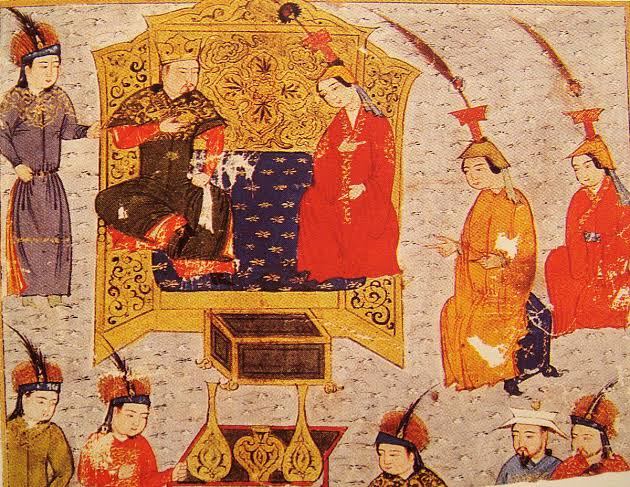
Fatima Khatun: The Grand Vizier of the Mongol Empire during the Regency of Töregene Khatun
Fatima Khatun was a Sayyid Iranian lady of the Alid lineage of Khorasan who, during the conquest of Tus and Mashhad al-Rida in the year 618 AH, was taken captive by the Mongols and sent to Karakorum, the capital of the Mongol sultans, located in the northern part of western Mongolia. An examination of her personality and her political and social activities reveals, on the one hand, the status of Alid women and their role on the international stage, and on the other, it vividly portrays the open and hidden rivalry between the Church and Islam and Iran in the continuation of the Crusades, which coincided with the beginning of the Mongol invasion of Iran. The earliest reports concerning Fatima Khatun go back to Juvayni’s Tarikh-i Jahan-Gushay (d. 681 AH) and to the period of Fatima Khatun’s captivity. Juvayni provides no information about her family; however, some later authors have reckoned her lineage among the Sayyids of Nughan, who were engaged in tile-work (kashi-kari) in the shrine of Ali ibn Musa al-Rida. Fatima Khatun’s father was Sayyid Ali Nughani, and her mother was Ma’sumeh Sadat, the “great bride” of the Nughani Sayyids.
According to historical reports, Tolui Khan, after completing the affair of Merv, prepared to seize the city of Nishapur and brought with him a vast army. The people of Nishapur resisted fiercely for three days, and on the fourth day the city fell to the Mongols. Although no direct report exists as to the time of Fatima Khatun’s captivity, it is probable, given the above report, that the captivity may have occurred during this attack. According to Juvayni, after her captivity Fatima engaged in brokerage (dalali) in the marketplace, and because she was very shrewd and intelligent, during the reign of Ögedei Qa’an she gained access to the ordu (camp) of Töregene Khatun. After Ögedei’s death, for a period of over four years the question of his succession remained unresolved, and during this time Töregene Khatun (r. 639–644 AH), the official wife of Ögedei, became regent.
At this time Fatima Khatun’s standing in governmental affairs increased, and alongside Töregene Khatun she intervened in all the governmental and political affairs of the empire. Juvayni writes: “When the situation changed and Amir Jinqai departed from the scene, her closeness increased and her authority reached its utmost extent.” Fatima Khatun’s proximity within the court grew to such a degree that she became trusted by the ruling establishment and the keeper of its secret confidences. Khwandamir relates this degree of trust in Fatima Khatun with particular expressions: “Töregene Khatun, who was the mother of Güyük and the other sons of the Qa’an, seated herself upon the throne of rule and undertook the regulation and ordering of the affairs of the realm, and through her firm judgment and far-seeing intellect, and by sending gifts and presents and winning over the army and the subjects, she inclined and attracted most of the notables and nobles to her obedience; and a woman named Fatima Khatun, who was among the captives of the sacred Mashhad, attained complete closeness to Töregene and became the keeper of her inner secrets and the administrator of confidential affairs, and for this reason she also intervened in the affairs of the kingdom and wealth.” It is reported that the great men lost their power, and commands and prohibitions were issued by her, to the extent that it is said that the true ruler was Fatima Khatun.
Töregene Khatun was the successor of Ögedei, the son of Genghis Khan, who ruled over all the Mongol conquests and empire, and now Fatima Khatun had become the principal center of decision-making and action within that empire. For this reason, the great men — especially the notables of Khorasan and a group of the Sayyids of the sacred Mashhad, who considered her to be descended from the lineage of the great Sayyids — sought Fatima Khatun’s intercession in order to win the support of the ruling establishment. Töregene Khatun, on her advice, dismissed the commanders and great state officials who had held the principal offices during the reign of Ögedei.
Töregene, on the advice of Fatima Khatun, in pursuit of her governmental policies, undertook a fundamental purge in order to cleanse the court of the viziers and commanders who had a bad record, or who acted negatively against Töregene’s rule and plunged the region into rebellion. She first dismissed Yelü Chucai, the adviser of Genghis Khan, and Mahmud Yalavach, the head of the divan and governor of Khitai, as well as Amir Jinqai, the vizier of Ögedei, and replaced them with a number of Iranian officials — among them Abd al-Rahman, who replaced Mahmud Yalavach, and Ali Khwaja, who was an Alid, whom she raised to the office of vizier. She also appointed Sharaf al-Din Khwarazmi as divan administrator (divan-salar) and Amir Imad al-Din as head of the chancery divan (divan-i kitabat).
With these measures, Fatima Khatun provided a secure environment for the migration of Iranians — especially the notables of Khorasan and a group of the Sayyids — and as a result a suitable ground was created for cultural and religious activity in the land of China, and the Iranians strongly influenced Chinese civilization. The most important Iranian figure who played a very influential role in the history of Chinese civilization was a person named Sayyid Ajall (d. 678 AH), who, after migrating to China and demonstrating his merits, became governor of Yunnan province and left great cultural and political effects behind him. Sayyid Ajall is known as the most important promoter of Islam in China, and his entry into China occurred shortly after the period of Fatima Khatun.
Among Fatima Khatun’s other policies for the development and progress of her homeland was the invitation to Töregene to visit Iran so that she might observe at close hand the condition of the plundered country after the Mongol invasion. Töregene Khatun traveled to Iran in the year 641 AH, and during the time she was in Iran she brought about changes, particularly in that over the conquered Mongol territories she brought to power a new group that was for the most part Iranian — not Mongol. At that time the condition of Iran was such that the Mongol khans would send a single person directly from Mongolia to Iran in order to administer the country; therefore Fatima Khatun replaced Gorguz, the Mongol amir of Iran, with Amir Arghun, and entrusted the administration of affairs from Amol to Fars, Georgia, Rum, and Mosul to Amir Arghun. Amir Arghun ruled over Iran for about thirteen years and set the affairs of Iran in order. Among Fatima Khatun’s other measures was her support for Iranian scholars who had been pushed to the margins as a result of Mongol oppression. For example, Ata-Malik Juvayni (d. 681 AH) was able, with Fatima Khatun’s support, to attain the position of secretary (dabiri) to Amir Arghun, and at that time he composed the Tarikh-i Jahan-Gushay, one of the most important sources for the history of Iran in the Mongol period.
Fatima Khatun’s shrewd measures had opened a path for the spread of Islam in the Mongol-conquered territories. Although Ögedei, during his reign, had preferred Islam over the other religions and at that time struck a seal bearing the name of the Prophet (peace be upon him) for himself — and this measure predated the rule of Töregene and the vizierate of Fatima Khatun — Fatima Khatun’s efforts to promote Islam were far more extensive. Her presence elevated Islam to the status of the religious priority in the land of China, to the extent that on the coins dating from the period of Töregene Khatun’s regency the names of Allah and Muhammad are clearly visible. She played an effective role in safeguarding the interests of Muslims in that era. Fatima Khatun’s reforms and extensive services caused Islam to be introduced to Chinese and Mongol society not through force and violence, but through gradual influence and the promotion of Islamic–Iranian culture. However, some of her policies — including the removal of the Mongol divan administrators and the bringing to power of civilized Iranians — did not sit well with her opponents, and the period of Fatima Khatun’s authority came to an end through their intrigues during the reign of Güyük Khan.
After the ratification of the quriltai assembly, Güyük Khan (r. 639–647 AH), the eldest son of Töregene, ascended the throne. Güyük had been raised under the supervision of a Christian and was therefore a follower of Christianity, and during his reign he remained under the influence of his Christian adviser, Amir Jinqai, who had been restored to power. The defeat of the Christians in the Crusades and the incitement of the Mongol Khan brought about a change in Güyük’s treatment of the Muslims and placed their position in jeopardy. He also came into sharp conflict with his mother, Töregene Khatun, over fundamental issues and political policy, and with the interference of Amir Jinqai, Fatima Khatun incurred the wrath and fury of Güyük and was arrested, tried, tortured, and finally put to death on the charge of collaborating with Töregene Khatun and inciting her to alter, replace, and banish the officials of Ögedei’s era, and on the charge of sorcery.
According to Juvayni’s report, after Ögedei’s death the enemies of the reforms temporarily prevailed, dismissing Gorguz from office and killing him. During the four and a half years in which Ögedei, Töregene, and her intimate companion Fatima Khatun always held power, a series of various measures were carried out in favor of the influential factions, until at last the great quriltai brought to power Töregene Khatun’s son, Güyük. At this time Kutan’s disability returned and the ailment he had grew worse; he sent a messenger to his brother Güyük Khan saying that the cause of his illness was the sorcery of Fatima, and that if any change should occur he should demand retaliation from her. On the heels of that news came the tidings of Kutan’s death.
Juvayni and Banakati also report in their books that day and night they kept Fatima Khatun thirsty, hungry, and naked, along with much torture, until at last she confessed to what she had or had not done, after which they wrapped her in felt and threw her into the water.
At this time Fatima Khatun’s associates and the group that had come from Khorasan were likewise pursued and exposed to danger and destruction. Khwaja Rashid al-Din Hamadani also mentions an Alid person from Samarkand named Ali Khwaja, who was one of the officials of the court of Güyük Khan. This person, in revenge for the killing of Fatima Khatun, slandered and brought accusations against the one responsible until they put him to death.
Through Fatima Khatun’s activities, the Muslims — whether in cultural and economic fields or in religious and doctrinal fields — had reached such a point at that time that it was thought Islam and Islamic culture would encompass that entire land; but with the influence of the Christians and, following that, the succession of Güyük and his spiteful policies against Fatima Khatun, it led to the horrific murder of this historical figure.
Sources
Ibrahim Ava, Tuhfa, and Keyvan Loloie (1378 SH). “Fatima Khatun Tusi: A Poetess of the Mongol Era.” Iran Shenakht Journal, no. 14.
Iqbal Ashtiani, Abbas (1364 SH). Tarikh-e Moghol: From the Invasion of Genghis to the Formation of the Timurid State. Tehran: Amir Kabir.
Banakati, Dawud ibn Muhammad (2007 CE). Rawdat Uli al-Albab fi Ma’rifat al-Tawarikh wa al-Ansab, known as Tarikh-e Banakati. Translated by Ali, Mahmoud Abd al-Karim. Cairo: National Center for Translation.
Bayani, Shirin (1353 SH). Iran in Confrontation with the Mongols. Tehran: Tahuri Library.
Barthold, Vasily Vladimirovich (1366 SH). Turkestan-nama. Translated by Karim Keshavarz. Tehran: Agah.
Torkamani Azar, Parvin (1383 SH). The Political History of the Twelver Shiites in Iran. Tehran: Shi’a Shenasi.
Tashakori, Saeed (1395 SH). Gharib-e Gharib, the Chinggisids. No place: Ketabestan-e Ma’refat.
Juvayni, Ala al-Din Ata-Malik Muhammad (1391 SH). Tarikh-e Jahan-Gushay. (Edited by Mohammad Qazvini.) Tehran: Negah Publications.
Khwand Mir, Ghiyath al-Din ibn Humam al-Din (1380 SH). Tarikh-e Habib al-Siyar fi Akhbar Afrad al-Bashar. Tehran: Khayyam.
Ravandi, Morteza (1396 SH). Tarikh-e Ijtima’i-ye Iran [A Social History of Iran]. Tehran: Negah.
Sayfi Haravi, Sayf ibn Muhammad (1381 SH). Pirasteh-ye Tarikh-nama-ye Herat. Tehran, Iran: Dr. Mahmoud Afshar Endowment Foundation.
Shami, Nizam al-Din (1363 SH). Zafarnama: The History of the Conquests of Amir Timur Gurkani. Introduction and effort by Panahi Semnani. Tehran: Bamdad.
Fazlullah, Rashid al-Din (1384 SH). Jami’ al-Tawarikh. Tehran: Written Heritage Research Center.
Muhammad Sallabi, Ali Muhammad (1430 AH). Kitab al-Mughul bayn al-Intishar wa al-Inkisar [The Mongols between Expansion and Collapse]. Egypt: Al-Andalus al-Jadida.
Muradzadeh, Reza (1382 SH). The Manner of the Penetration and Spread of Islam in China. Mashhad: Islamic Research Foundation.
Mir Khwand, Muhammad ibn Khawand Shah (1270 AH). Rawdat al-Safa. No place, no publisher.
Valeh Isfahani, Muhammad Yusuf (1390 SH). Khuld-e Barin (On Mongol History), Fifth Garden. Edited by Mir Hashem Mohaddes. Tehran: Institute for Humanities and Cultural Studies.
Roux, Jean-Paul (2003). L’Asie Centrale. Paris: Fayard ; De Nicola, Women in Mongol Iran: The Khatuns, Edinburgh University Press, 2017.
Lane, George (June 29, 2011). “SAYYED AJALL.” Encyclopædia Iranica. Encyclopædia Iranica. Retrieved 17 November 2012.
玉溪《使者》 [Yuxi, “The Envoy”]. CCTV.com (in Chinese). Director: Han Ling (编导:韩玲); Photography: Li Bin (摄像:李斌). CCTV International (央视国际). 2005-02-24. Retrieved 24 April 2014.
He, Gaoji; Lu, Junling, eds. (2013). 域外集 [Collection Beyond the Borders]. Beijing: Zhonghua Book Company.
Niyama. “Coin of the Mongol Regent Toregene” (29 October 2019). Retrieved from: https://www.worldhistory.org/image/11423/coin-of-the-mongol-regent-toregene/
[7]. Juvayni, Tarikh-e Jahan-Gushay, vol. 1, p. 200.
[8]. Juvayni, Tarikh-e Jahan-Gushay, vol. 1, p. 196; Banakati, Rawdat Uli al-Albab fi Ma’rifat al-Tawarikh wa al-Ansab, p. 428.
[9]. Juvayni, Tarikh-e Jahan-Gushay, vol. 1, p. 200; Khwand Mir, Tarikh-e Habib al-Siyar, vol. 3, p. 55.
[10]. Juvayni, Tarikh-e Jahan-Gushay, vol. 1, p. 200.
[11]. Khwand Mir, Ghiyath al-Din ibn Humam al-Din, Tarikh-e Habib al-Siyar fi Akhbar Afrad al-Bashar, vol. 3, p. 55.
[12]. Juvayni, Tarikh-e Jahan-Gushay, vol. 1, p. 199; Muhammad Sallabi, Kitab al-Mughul bayn al-Intishar wa al-Inkisar, vol. 1, p. 180.
[13]. Bayani, Iran in Confrontation with the Mongols, p. 119.
[14]. Juvayni, Tarikh-e Jahan-Gushay, vol. 1, p. 199.
[15]. Juvayni, Tarikh-e Jahan-Gushay, vol. 1, p. 200.
[16]. Ali Muhammad Muhammad al-Sallabi, Al-Mughul bayn al-Intishar wa al-Inkisar, vol. 1, p. 180.
[17]. Juvayni, Tarikh-e Jahan-Gushay, vol. 1, pp. 196–199; “Fatima Khatun Tusi: A Poetess of the Mongol Era,” p. 85.
[18]. In some sources, the name of Yelü Chucai is given as Muhammad Yeluaj. Iqbal Ashtiani, Tarikh-e Moghol-ha, p. 152.
[19]. Iqbal Ashtiani, Tarikh-e Moghol-ha, p. 136.
[20]. Juvayni, Tarikh-e Jahan-Gushay, vol. 1, p. 197.
[21]. Juvayni, Tarikh-e Jahan-Gushay, vol. 1, p. 278; Fazlullah, Jami’ al-Tawarikh, vol. 1, p. 565.
[22]. Juvayni, Tarikh-e Jahan-Gushay, vol. 1, p. 280.
[23]. 玉溪《使者》 [Yuxi, “The Envoy”]. CCTV.com (in Chinese). Director: Han Ling (编导:韩玲); Photography: Li Bin (摄像:李斌). CCTV International (央视国际). 2005-02-24. Retrieved 24 April 2014.
[24]. He, Gaoji; Lu, Junling, eds. (2013). 域外集 [Collection Beyond the Borders]. Beijing: Zhonghua Book Company. p. 99.
[25]. Bayani, Shirin, Iran in Confrontation with the Mongols, p. 31.
[26]. Bayani, Shirin, Iran in Confrontation with the Mongols, p. 32.
[27]. Iqbal Ashtiani, Tarikh-e Moghol, p. 166.
[28]. See the editor’s introduction to Jahan-Gushay, vol. 1, pp. 23–25.
[29]. Lane, George. “Sayyed Ajall.” Encyclopaedia Iranica.
[30]. Tarikh-e Ijtima’i-ye Iran [A Social History of Iran], vol. 2, p. 301.
[31]. Niyama. “Coin of the Mongol Regent Toregene” (29 October 2019). Retrieved from: https://www.worldhistory.org/image/11423/coin-of-the-mongol-regent-toregene/
[32]. Shami, Zafarnama: The History of the Conquests of Amir Timur Gurkani, p. 128; Torkamani Azar, The Political History of the Twelver Shiites in Iran, p.