
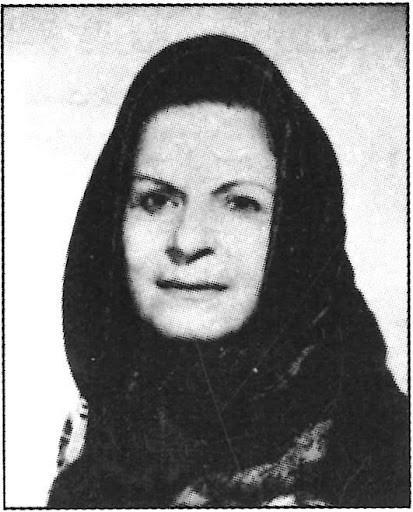
Āṣefe-Aʿẓam Āṣafi (1925–2003)
was one of the prominent and influential figures in the field of modern Iranian education, who took effective steps toward institution-building in the realm of upbringing by focusing on the bond between home and school.
Biography and Family Background
Āṣefe-Aʿẓam Āṣafi was born in 1925 in Tehran, into a family with a cultural and political background. Her father, Moḥammad Āṣafi, was an army officer, and her mother, Forūgh-Aʿẓam Qāʾem-Maqāmī, was a descendant of Qāʾem-Maqām Farāhānī. She pursued her education and, in her youth, married Parvīz Khānsārī (one of the politicians of the Pahlavi era), a marriage that produced three children.
Education and Academic Activities
After completing her secondary education, Āṣafi began her academic path at the University of Tehran:
-
1957:
- Received a bachelor’s degree in French Language and Literature from the University of Tehran.
-
Beginning of her professional career:
Teaching at the “Higher Teachers’ College of Tehran” (today’s University of Teacher Education / Tarbiat Moallem University).
-
1962:
- Earned a doctorate in Education from the Sorbonne University in Paris.
After returning to Iran, she was promoted to the rank of associate professor in 1969 and to the rank of full professor in 1975 in the Department of Educational Sciences. Her specialized teaching areas included theories of education, the sociology of education, and educational psychology. She also taught at numerous educational centers, including the Police University and the School of Administrative and Commercial Sciences in Qazvin.
Founding of the National Association of Parents and Teachers
The turning point of Āṣafi’s professional activities was her effort to organize the interaction between family and school. In Mehr (September–October) 1967, she founded the “National Association of Parents and Teachers” as a non-governmental and non-profit institution.
Goals and activities of this association:
- Improving the quality of education through the cooperation of parents and teachers.
- Establishing the “Family Education Center” in 1973.
- Holding educational sessions, screening educational films, and providing counseling services.
- Publishing the monthly magazine Maktab-e Mā (School of Mother); one of the first specialized journals in the field of educational sciences and family education in Iran.
International Activities
By attending conferences and conducting scientific research in countries such as France, Italy, Japan, England, and Ireland, Āṣafi worked toward the localization of modern educational models. Her research in England and France focused particularly on methods of rehabilitation and education of delinquent children.
Works and Publications
She published numerous works in the fields of education, the pathology of family relationships, and child psychology. Among her notable works, the following can be mentioned:
- Mabānī-ye Falsafe (Foundations of Philosophy) — published by Āgāh.
- Negāhī be Adab-e Pārsī (A Look at Persian Literature).
- Āʾīn-e Negāresh (The Art of Writing).
Final Years and Legacy
Dr. Āṣafi retired in Ordibehesht (April–May) 1979 after years of scientific activity. She passed away in 2003 in Tehran at the age of 78. Āṣefe-Aʿẓam Āṣafi can be regarded as one of the pioneers of educational institution-building in Iran, who, with a comprehensive vision, consolidated the place of the family as a fundamental pillar of the educational system.
Sources
- National Association of Parents and Teachers (1968–1979). Maktab-e Mā Magazine. Tehran.
- Āṣafi, Āṣefe (1992). Mabānī-ye Falsafe. Tehran: Āgāh Publications.
- Āṣafi, Āṣefe (1973). Negāhī be Adab-e Pārsī. Qazvin School of Higher Studies in Administrative and Commercial Sciences.
- Āṣafi, Āṣefe (1973). Āʾīn-e Negāresh. Tehran: Ghazālī Higher School.
- Bājnowordī, Moḥammad-Kāẓem (2013). Dāneshnāme-ye Tehrān-e Bozorg. Tehran: Center of the Great Islamic Encyclopedia.
- Barzīn, Masʿūd (1992). Shenāsnāme-ye Maṭbūʿāt-e Īrān. Tehran: Behjat.
- Behnūd